Philosophy Gate: R.B. Barnes
Philosophy Gate Interviews R.B. Barnes, Philosopher, Cosmologist.

If you enjoy this interview with R.B. Barnes, please subscribe to his Substack: R.B. Barnes
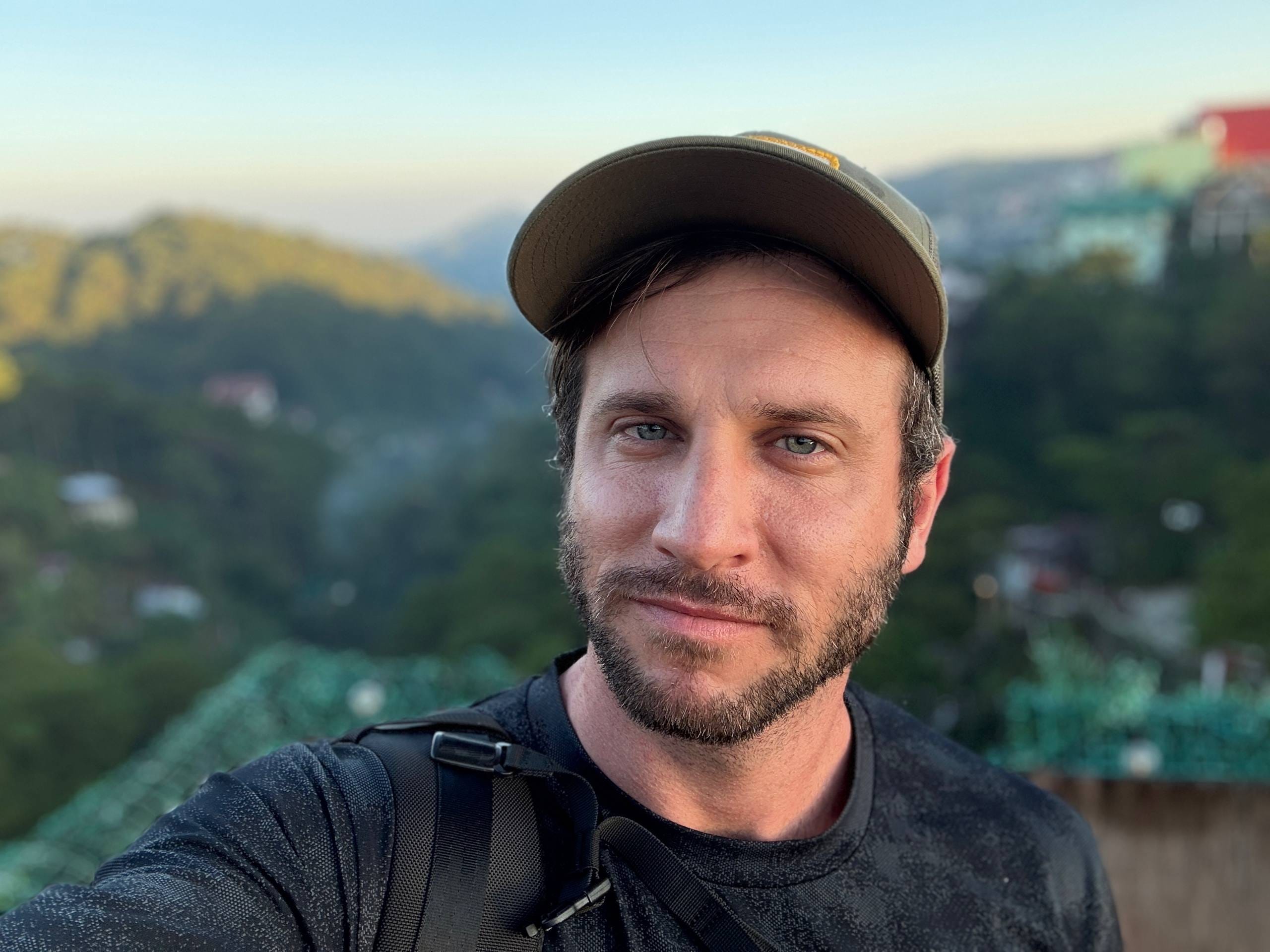
Editor's note, July 14, 2026: The mandate below has been lifted. Barnes is R.B. Barnes, Ronald Blake Barnes. The full story:

Please note: in order to conduct this interview, R.B. Barnes mandated that we not share his academic accolades or identity. He explicitly demands, "The work must stand alone, without me." Though we can vouch, and do have his permission to say, that Barnes has three letters in front of his name and more behind it.
Before you had the vocabulary, what were you already doing that turned out to be philosophy?
Practice. I understood at a very young age that there was a direct link between effort applied to something and end result, and I understood that the path was sometimes indirect: it was worth practicing even when things were not leading to the result directly. I was a pretty athletic kid, so practice was fun for me, and I kept seeing that the more I was having fun the better I was becoming, and the better I became the more fun I could have. It was a recursive state I loved participating in, and it really did not matter the subject.
At some point I realized you could practice things that were not physical by visualizing them in your head. I would replay my day before falling asleep and denote things I could do better tomorrow based on whatever my little value set was as a tiny kid. A lot of it was shaped by Captain Planet and Power Rangers and then the Bible. I would look for things like: was I not brave here? I was already trying to emulate virtues I admired, things that were bigger than me.
What does your thinking look like before it’s ready for other people to see?
It involves mass amounts of thinking and often pacing, and I am a regrettably harsh critic of my own thoughts. I have strict criteria for material I will work with, and I am heavily inspired here by the alchemical process of obtaining purity. I do not want to say more than that, otherwise I give away how I come to conclusions. But I view my thinking as a process, and I have no hard feelings towards any of my thoughts that I have to get rid of in order to find good ones. I view this as a natural part of the process. It is a pretty ruthless situation.
What do you keep returning to, from any domain, that has no business being as important to your intellectual life as it is?
Psychoanalysis. It has always been a keen interest of mine, and I feel it had great potential to further and conjoin with philosophy until it collapsed under its own weight. Much was lost when the father of the field died, and by then it had ballooned into a body desperately wanting to act without its nervous system. Once the nervous system failed, the body spasmed and flung in different directions hoping to create subgenres of its study, but did this too soon in its infancy, and its reputation became mired in quackery and subsequently dismissed as unserious. But this need not be the case. There is a necessarily applicable human element in psychoanalysis that philosophy, with all its malignancies, still lacks.
What idea do you keep encountering that you believe is genuinely wrong, and what makes it so hard to kill?
That we are more intelligent than we are. We flatter ourselves endlessly. We are little more than monkeys, and this all services the ego. Consider the cultural divide between ideologies: we behave as though it can be bridged through reason, as though it is a problem of information or persuasion. It is not. It is too tied to coming of age and identity to be malleable for large populaces. This is a developmental fact, not a political one, and it is the kind of fact the ego refuses to accept because accepting it means admitting that our convictions are less chosen than inherited. It is hard to kill because the ego defends its own sovereignty above all else.
What do you believe that most of your peers would say is simply wrong?
That mathematics is not the foundation we imagine it to be. It isn’t bedrock we discovered. It’s a language we built.
It’s the most rigorous tool we have for eliminating bias: accept the axioms, and the conclusions are forced. But that objectivity is borrowed, not absolute. It doesn’t remove bias so much as move it upstream, into the axioms, which are chosen rather than found. For two thousand years the parallel postulate looked like a necessary truth about space. Abandoning it didn’t break geometry. It opened up new and equally consistent geometries, the very ones that turned out to describe real spacetime. The “necessary truths” were choices all along. Gödel sealed it: no system rich enough to be interesting can prove its own consistency or contain all its own truths, so mathematics cannot even serve as its own foundation. We read its success in physics as proof that it’s woven into the universe, but we keep the math that fits what we observe and quietly forget the rest.
What I’m really saying is that our mathematics is Latin. Not wrong, the way Cicero’s grammar is not wrong, but contingent, and one day a relic: the language future minds will study to see how we once described the world, before something we don’t yet have the mind to picture takes its place.
What do you do that has nothing to do with philosophy but that you suspect makes you better at it?
Nothing. All I do is in service of the pursuit of knowledge. Though in all seriousness, I am a steward above and before all else. This means that I am the least in every room, that I listen more than all other things, and that I trust no words spoken or read by man, no matter their reputation, unless I parse them first. Even my own.
What question are you living with right now that you can’t yet answer?
Myriad. I am perpetually, casually wonderstruck. I think of Chesterton and his ability to get lost: he once telegraphed his wife Frances from Market Harborough, “Am here. Where ought I to be?” and she replied, “Home.” I think he and I would be happily lost together. I consider this (philosophy) my personal playground, so I find myself genuinely overjoyed when I happen across something I do not know, especially if it is an entire subject. I consume until I feel I have a level of mastery and then move onto the next perplexing thing using what I have learned.
But if I must name one: how will we make it if we do not work together?
If one idea from your work could outlast everything else you’ve written, which would you want it to be, and is it the one most people would expect?
I could not care less about this. I do the work because it is meant to be done by me. The work is meaningless without action from the individual who encounters it: I do not merely want to partake in the thought process of a reader, I want to engage with them, and I want them to engage with the text in order to further goals, conclusions, understanding. This work is not for me. What am I going to do with it? I only speak and write about what I know.
What have you changed your mind about that cost you something to admit?
I love these moments and have zero shame in admitting when I am wrong or sorry. I change my mind constantly. I am always looking for ways to build upon my worldview, so when I am wrong it is greatly important to me, because I am learning, and I firmly only care about the pursuit of our knowledge as a people, not my ego.
I was corrected by a good friend of mine, Dr. Kim, who told me that I only saw the world in black and white, and forgot about all of the colors, let alone the shades of gray. I am grateful for this every day.
What’s a sentence, from anyone, anywhere, that you keep returning to?
"Know who you're quoting."
It is mine. I am loath to quote other men. I have said it my whole life, because people quote others like fools, never knowing who said it, the context, or why.
This reminds me of people who quote Kant without knowing Kant: a man who literally thought all babies were born white and that evil blackness spread through them as they aged, and this is the man you are relying on for reason? The man who never left his hometown writing travel treatises? Embarrassing.
"You are only afforded so many moments to find out what you are made of."
Again, my own.
"Your time spent betrays value."
Philosophy Gate’s favorite works by R.B. Barnes:
Book: The Prior Grammar (Amazon) https://www.amazon.com/Prior-Grammar-Two-Essays/dp/B0H1LGWX5P/
Post: The Double Yes

Post: Plastic Symbolism
Post: The Adjacent Case
I love this. With a guy like RB B, I am endlessly curious about his thoughts on anything really
One of the all time greats